Free ACS Citation Generator - American Chemical Society Format | Kuse
Free ACS citation generator powered by AI. Automatically format journal articles, books, and web sources in American Chemical Society style in seconds.
GENERAL

Claude Sonnet 4.5

Claude Opus 4.5

GPT-5.1
GPT-5 Thinking

Gemini 3.0 Pro
IMAGE
Nano Banana Pro
Nano Banana








Key Features
Instant ACS Formatting
DOI Auto-Import
Multiple Source Types
Batch Citation Generation
Journal Name Abbreviation
Export & Integration
All Your Favorite Models, One Unified Place.
Bring your own sources and let the top-tier AI handle the rest. Whether it’s deep research with Claude, creative drafting with GPT, or complex data reasoning with Gemini, Kuse empowers you to understand and create using a versatile ensemble of industry-leading intelligence.


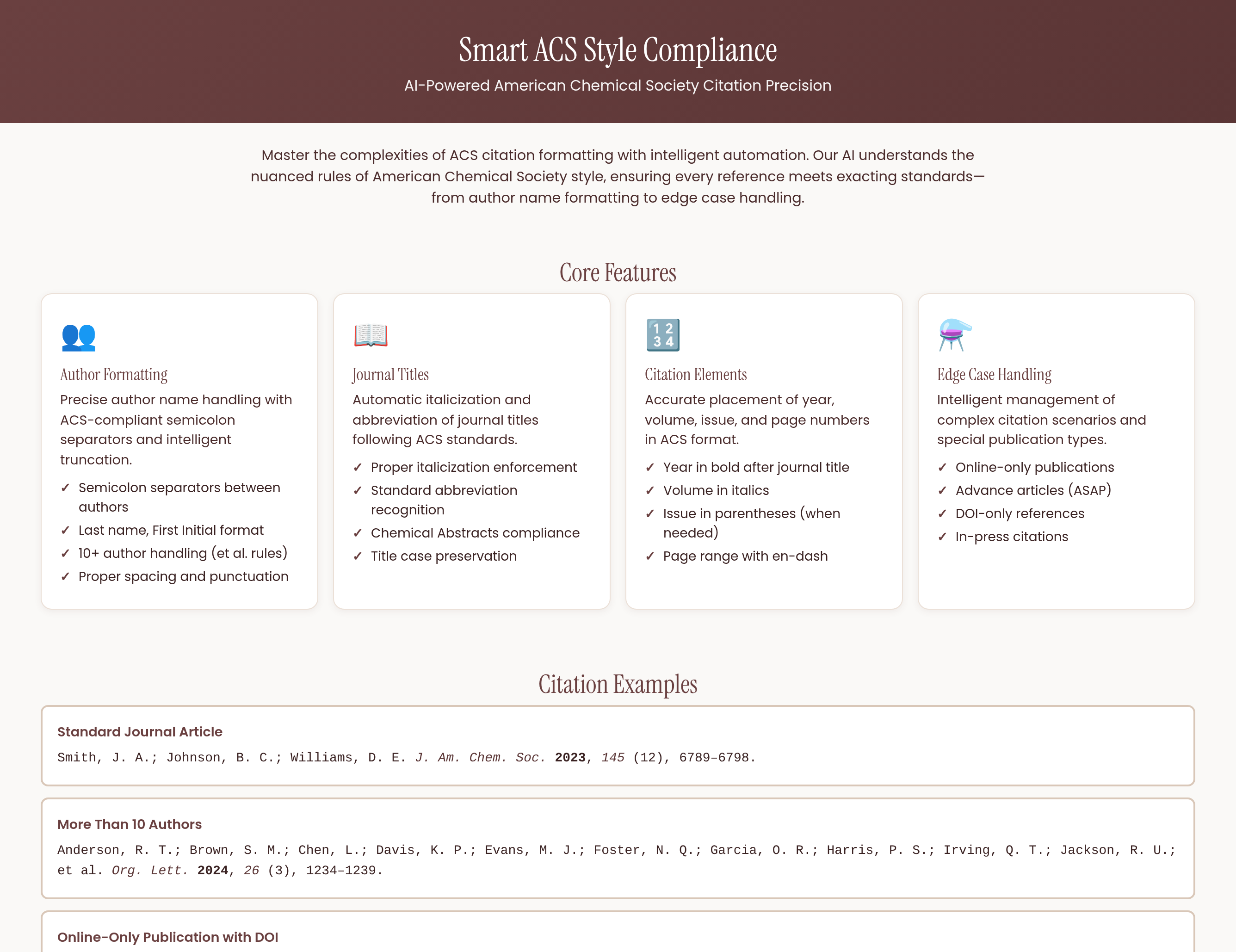
Smart ACS Style Compliance
Our AI understands the nuances of ACS citation rules — from author name formatting with semicolons to proper italicization of journal titles and correct placement of year, volume, and page numbers. It handles edge cases like more than ten authors, online-only publications, and advance articles automatically.
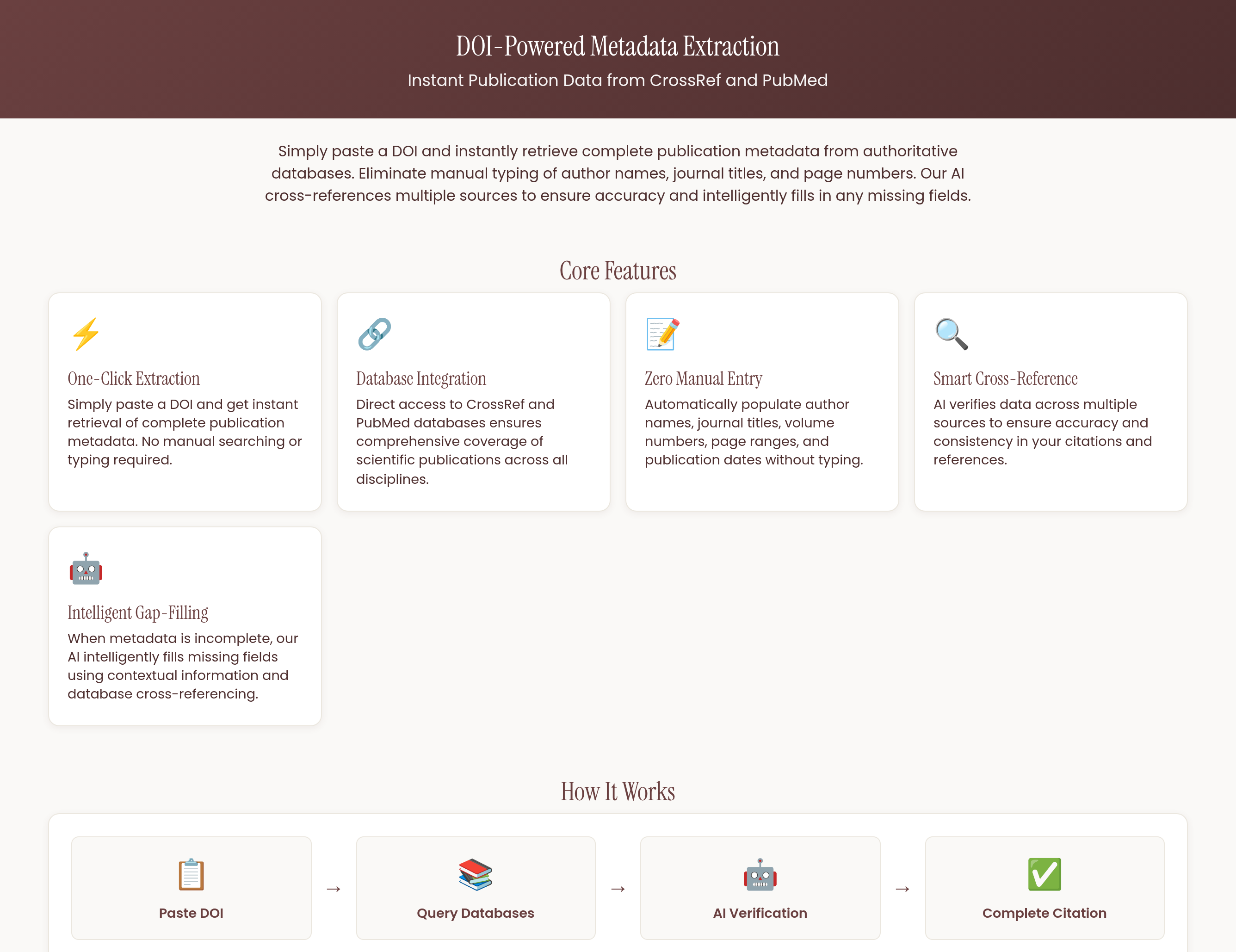
DOI-Powered Metadata Extraction
Simply paste a DOI and the generator retrieves complete publication metadata from CrossRef and PubMed databases. No more manually typing author names, journal titles, or page numbers. The AI cross-references multiple sources to ensure accuracy and fills in missing fields intelligently.
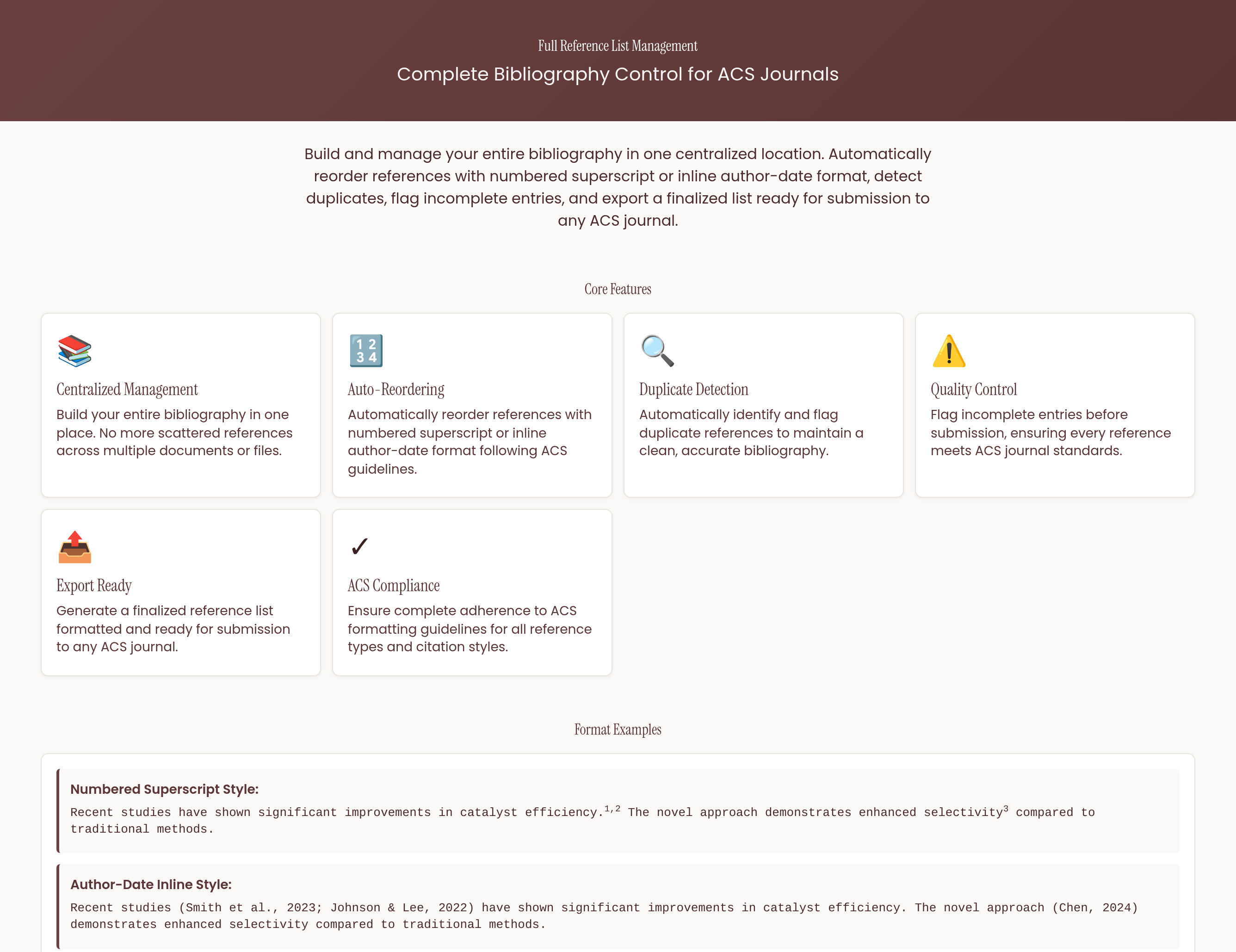
Full Reference List Management
Build and manage your entire bibliography in one place. Reorder references automatically with numbered superscript or inline author-date format per ACS guidelines. Detect duplicates, flag incomplete entries, and export your finalized list ready for submission to any ACS journal.
Explore Our Advanced AI Tools





What Is an ACS Citation Generator?
An ACS citation generator is an AI-powered tool that automatically formats your research sources according to the American Chemical Society (ACS) Style Guide. Whether you're writing a lab report, research paper, or thesis in chemistry, biochemistry, or related sciences, proper ACS citations are essential for academic credibility and journal acceptance.
Manually formatting ACS citations can be tedious and error-prone. The style has specific rules for author names, journal abbreviations, italicization, punctuation, and numbering that differ significantly from other formats like APA or MLA. An AI-powered ACS citation generator eliminates these challenges by handling all formatting rules automatically.
Who Needs an ACS Citation Generator?
This tool is designed for anyone working within the chemical sciences who needs properly formatted references:
- Chemistry students writing lab reports, term papers, and dissertations
- Graduate researchers preparing manuscripts for ACS journals like JACS, Organic Letters, or ACS Nano
- Professors and instructors creating course materials and review articles
- Industry scientists drafting internal reports and patent applications
- Technical writers producing documentation for chemical and pharmaceutical companies
How ACS Citation Format Works
The ACS citation style follows specific conventions that set it apart from other academic formats. Understanding these rules helps you verify that your generated citations are correct.
Journal Article Format
The standard ACS format for a journal article follows this structure: Author Last Name, First Initial. Second Initial.; Additional Authors. Article Title. Abbreviated Journal NameYear, Volume, Page Range.
For example: Smith, J. A.; Lee, K. M.; Wang, R. Catalytic Methods for Asymmetric Carbon–Carbon Bond Formation. J. Am. Chem. Soc.2024, 146, 1234–1245.
Book Format
Books in ACS style are cited as: Author Last Name, First Initial. Second Initial. Book Title, Edition; Publisher: City, Year.
Website Format
Web sources include the URL and access date: Author or Organization. Title of Page. URL (accessed Month Day, Year).
How to Use the Free ACS Citation Generator
Creating properly formatted ACS citations takes just a few simple steps:
- Step 1: Enter your source information. You can paste a DOI for automatic import or manually type the details such as authors, title, journal name, year, volume, and pages.
- Step 2: Select the source type — journal article, book, book chapter, website, patent, or dissertation.
- Step 3: Click generate. The AI formats your citation according to the latest ACS Style Guide, including proper journal abbreviations and author formatting.
- Step 4: Review, edit if needed, and copy the citation or export your entire reference list.
Key Benefits of Using an AI ACS Citation Generator
Save Time on Formatting
Formatting ACS citations manually requires memorizing dozens of rules for different source types. An AI citation generator handles all variations instantly, freeing you to focus on your actual research and writing.
Reduce Errors
Common ACS formatting mistakes include incorrect journal abbreviations, wrong author name formatting, and misplaced punctuation. The AI cross-references databases to ensure every element is correctly placed and formatted.
Stay Current with ACS Guidelines
ACS citation rules are updated periodically. Our generator follows the latest edition of the ACS Style Guide, so you don't need to worry about outdated formatting conventions.
Handle Multiple Source Types
From standard journal articles to patents, conference proceedings, and government reports, the generator supports every source type recognized by the ACS Style Guide with proper formatting for each.
Tips for Better ACS Citations
- Always verify DOI imports: While DOI auto-import is highly accurate, occasionally metadata databases contain errors. Quickly review generated citations against the original publication.
- Check journal abbreviations: ACS requires standard CAS Source Index (CASSI) abbreviations. Our generator handles this automatically, but it's good practice to verify unusual journal names.
- Use numbered references: Most ACS journals use superscript numbered references in text. Ensure your in-text citations match your reference list numbering.
- Include all authors: ACS style lists all authors for references with up to ten authors. For more than ten, list the first ten followed by "et al."
- Add access dates for web sources: Online references require the date you accessed the content, formatted as "accessed Month Day, Year."
ACS vs. Other Citation Styles
Understanding how ACS differs from other common citation formats helps you choose the right style for your work:
- ACS vs. APA: APA uses author-date in-text citations while ACS primarily uses numbered superscripts. ACS also uses semicolons between authors whereas APA uses commas and ampersands.
- ACS vs. MLA: MLA is used in humanities and uses author-page number in-text citations. ACS is specific to chemistry and related sciences with very different formatting conventions.
- ACS vs. Vancouver: Both use numbered references, but they differ in punctuation, author formatting, and journal abbreviation conventions.
Start Generating ACS Citations for Free
Stop spending hours manually formatting your chemistry references. Our free ACS citation generator uses AI to produce accurate, properly formatted citations in seconds. Whether you're working on a single lab report or a multi-chapter dissertation, this tool ensures your references meet ACS standards every time. Try it now — paste a DOI or enter your source details and get perfectly formatted ACS citations instantly.
FAQs
ACS (American Chemical Society) citation style is the standard referencing format used in chemistry, biochemistry, and related scientific disciplines. You should use ACS style when submitting papers to ACS journals like JACS, Organic Letters, or ACS Nano, or when your instructor or institution requires it. The style uses numbered superscript references in text with a corresponding numbered reference list.
Yes, simply paste a DOI into the generator and it will automatically retrieve all publication metadata — including authors, article title, journal name, volume, pages, and year — from databases like CrossRef and PubMed. The tool then formats everything according to ACS Style Guide conventions, including proper journal abbreviations and author name formatting. Always do a quick review to confirm accuracy.
ACS style uses numbered superscript in-text citations with a numbered reference list, while APA uses author-date parenthetical citations and MLA uses author-page number. ACS also has unique conventions like semicolons between authors, specific CAS journal abbreviations in italics, and bolded publication years. These differences make it essential to use a dedicated ACS citation generator rather than a generic tool.
Yes, our ACS citation generator is completely free. You can generate unlimited citations for journal articles, books, websites, patents, and other source types without creating an account. The tool supports DOI auto-import, batch processing, and export in multiple formats including plain text, BibTeX, and RIS for seamless integration with your writing workflow.